Round 01
/
08 Aug
Canadian GP

Calgary, Canada
McMahon Stadium
McMahon Stadium
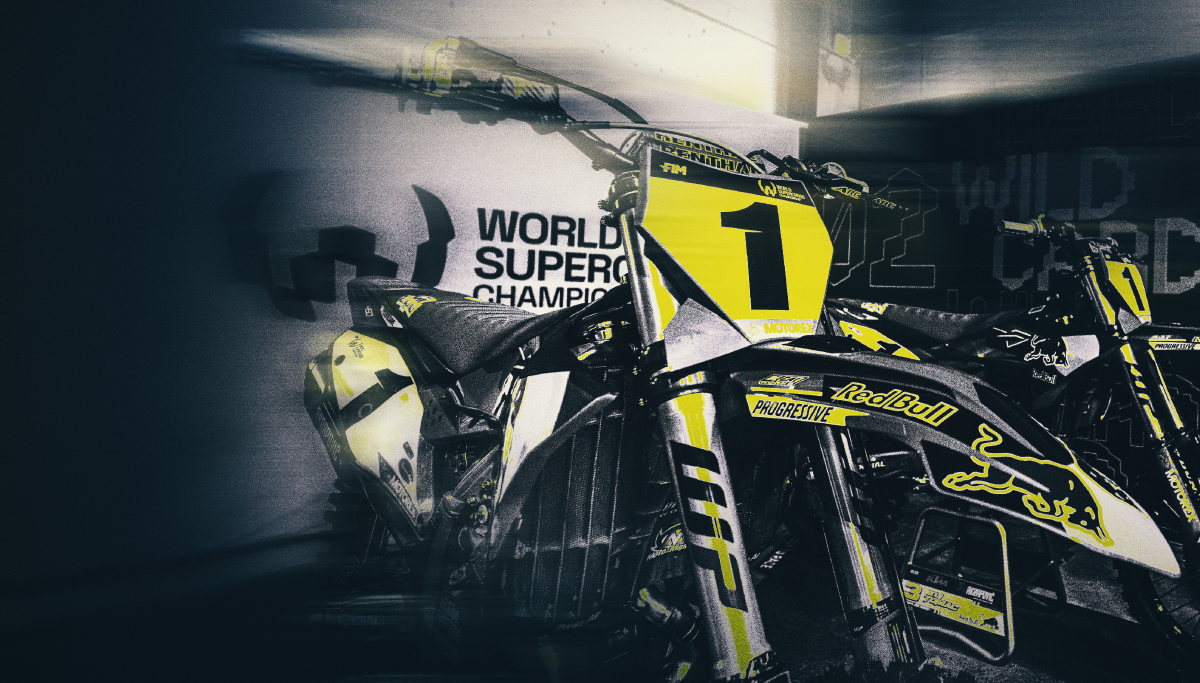
While fans are often focused on the rider’s, every lap is a showcase of cutting-edge motorcycle technology working in harmony with elite athleticism.
For seasoned Supercross followers and riders who already understand the basics, a deeper look at the anatomy of a modern dirt bike reveals just how much engineering goes into every gate drop.
At the center of every race bike sits a high-performance four-stroke engine. Although production-based, the engines used by factory teams are meticulously developed to maximise power delivery, throttle response, and reliability.
Modern 250SX and 450SX race bikes rely on lightweight internal components, advanced engine mapping, and precise fuel injection systems to deliver usable power throughout the RPM range.
In Supercross, outright horsepower is only part of the equation. Riders need instant acceleration out of corners, controllable torque through technical rhythm sections, and smooth delivery when traction is limited.
Engine tuning is often tailored to a rider’s style, track conditions, and race strategy, making the powerplant one of the most personalised aspects of the motorcycle.
The World Supercross Championship is also unique in that it that the all-electric powered Stark competes on a level playing field against its traditional fuel-powered rivals. The battery and motor technology is strictly monitored by the the Championships’ governing body to ensure parity with the SX1 and SX2 classes in which it competes.
The frame serves as the foundation of the motorcycle. Most modern Supercross machines utilise aluminum perimeter frames designed to provide an ideal balance between rigidity and flex.
Too much stiffness can make a bike feel harsh and unpredictable, while excessive flex can reduce cornering precision and confidence.
Manufacturers spend countless hours refining frame characteristics to ensure the motorcycle remains stable through whoops, responsive in tight corners, and predictable during hard landings.
The frame works as a complete system alongside the swingarm, suspension, and engine mounts, all of which influence handling characteristics.
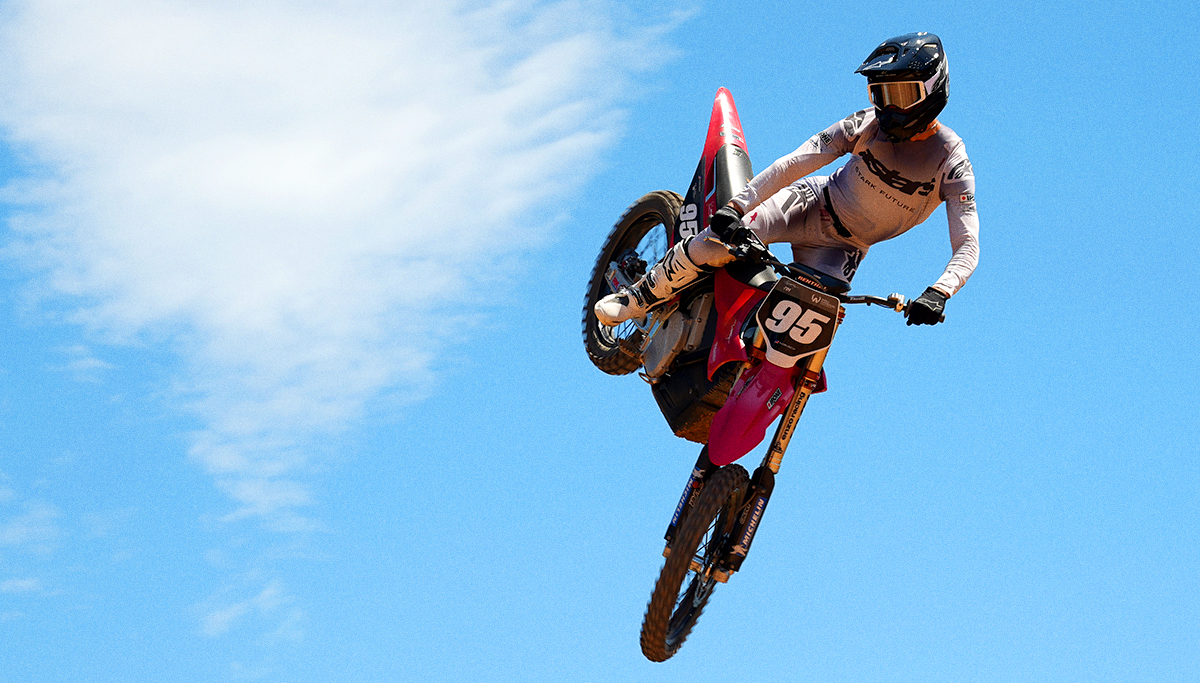
Few components have a greater impact on Supercross performance than the suspension. The front forks and rear shock are responsible for managing everything from braking bumps to 70-foot jump landings.
Factory suspension systems are extensively customised for individual riders. Spring rates, damping settings, ride height, and internal valving are adjusted to match rider preferences and track demands.
In Supercross, suspension must perform multiple tasks simultaneously. It needs to absorb impacts, maintain tyre contact with the ground, resist bottoming on large jumps, and provide feedback that allows riders to attack obstacles confidently.
The ability to skim whoops at race speed often comes down to suspension setup as much as rider technique.
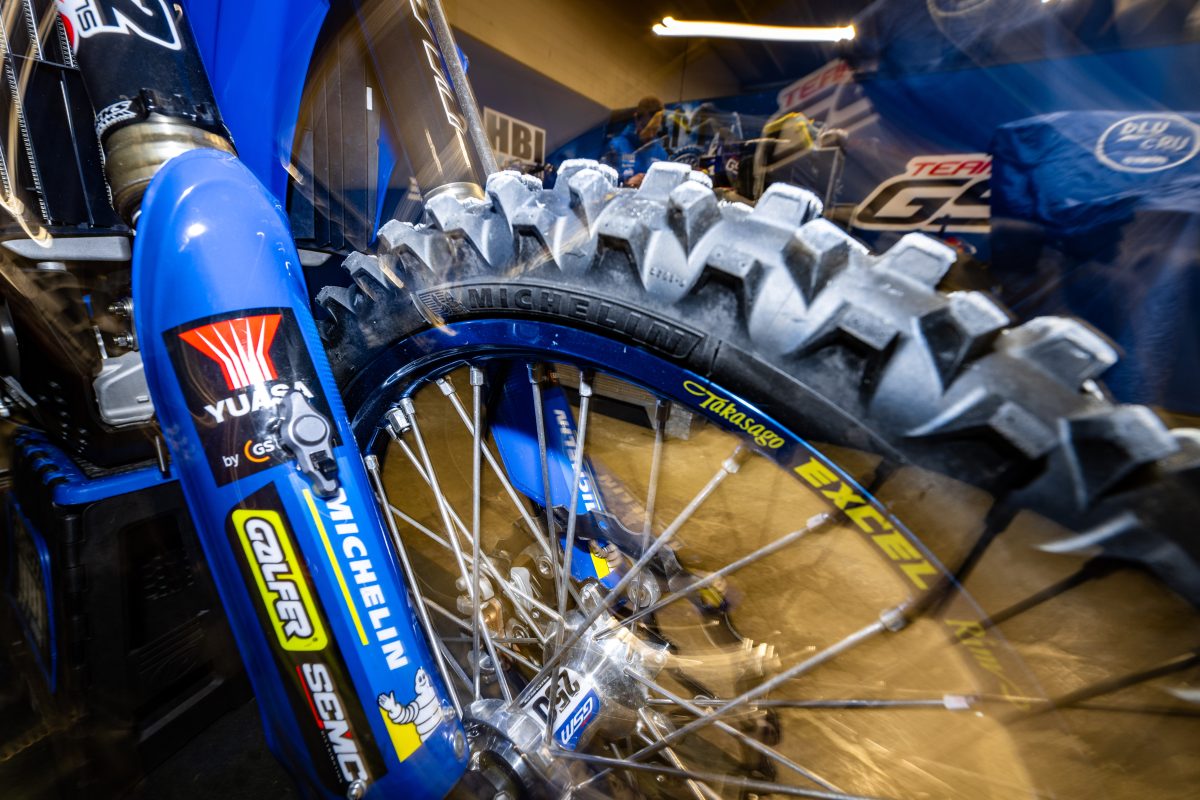
The only connection between a Supercross bike and the track is its tyres. As a result, tyre selection and setup play a critical role in race performance.
Lightweight wheels help reduce unsprung weight, allowing the suspension to react more effectively to changing terrain. Meanwhile, tyre compounds and tread patterns are selected based on track composition, moisture levels, and race conditions.|
Traction is everything in Supercross. A tyre that hooks up exiting a corner can be the difference between clearing a rhythm section or losing valuable time to competitors. Even subtle changes in pressure can significantly impact handling and grip throughout a race.
Modern Supercross motorcycles utilise hydraulic disc brakes front and rear. While braking systems may appear simple compared to engines or suspension, they are critical to lap-time performance.
Riders rely heavily on front brake control entering corners and approaching technical sections. Brake feel, modulation, and consistency become especially important during main events when tracks develop deep ruts and rough braking zones.
Teams often use specialised components designed to improve heat management and provide consistent performance throughout the race.
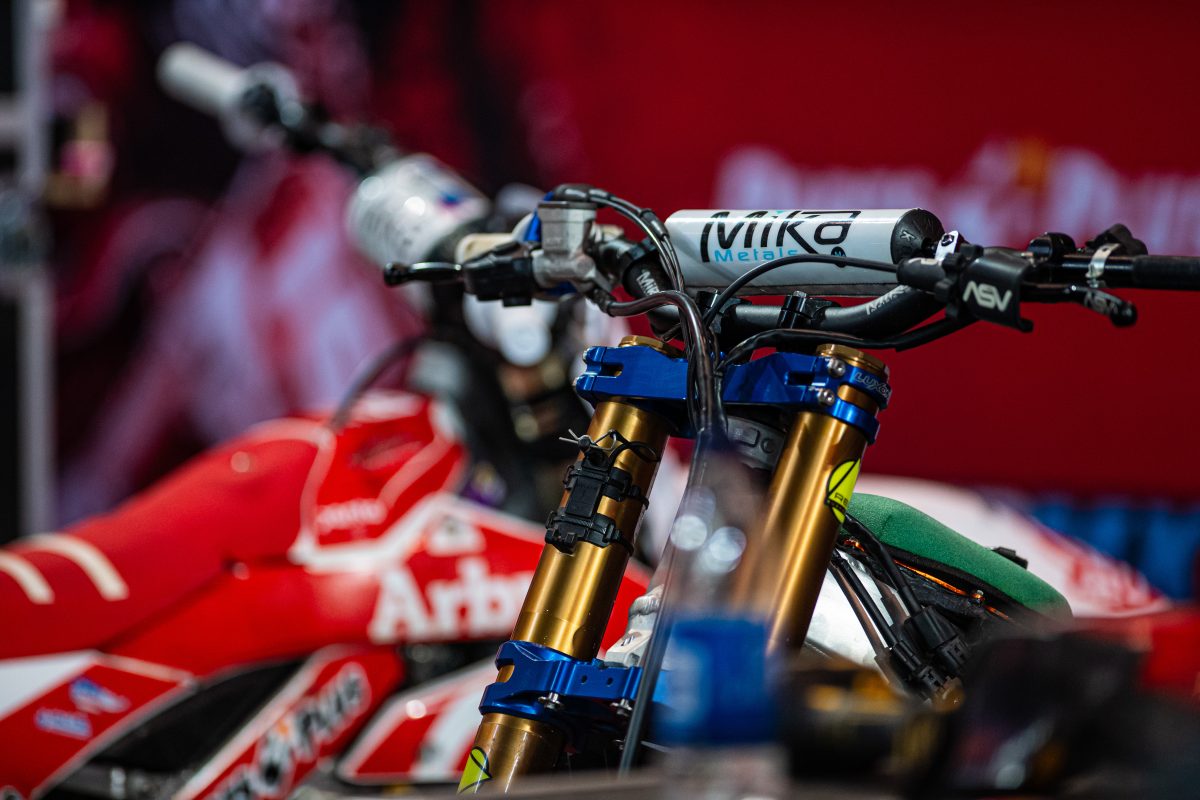
Every rider interacts with the motorcycle through a carefully tailored control setup. Handlebars, grips, levers, throttle assemblies, and foot controls are selected to maximise comfort and precision.
Small adjustments in handlebar position, lever angle, or foot peg placement can significantly affect rider confidence and control. Because Supercross demands constant body movement, ergonomics are a major consideration when preparing a race bike.
A team’s mechanics work closely with riders to create a setup that feels natural and allows them to react instinctively during competition.
Power generated by the engine reaches the rear wheel through the drivetrain, consisting primarily of the clutch, transmission, chain, and sprockets.
Gear ratios are often adjusted depending on the track layout. A circuit with long rhythm sections may require different gearing than one featuring tighter corners and shorter transitions.
The clutch is particularly important in Supercross. Riders frequently use clutch control to manage traction, fine-tune power delivery, and maintain momentum through technical sections. Precision in this area can create advantages measured in tenths of a second.
Like the engine, this is different for the Stark bikes, where the consists of an electric motor and there is no clutch, meaning an altogether different riding style is required when it comes to managing the power.
The plastic bodywork found on modern race bikes does more than provide visual identity. Shrouds, side panels, and fenders are designed to allow unrestricted rider movement while protecting critical components.
Riders constantly shift their weight forward, backward, and side to side throughout a lap. The shape and layout of the bodywork directly influence how effectively they can move around the motorcycle.
Seat design also plays a role, particularly during starts and corner exits where body positioning is crucial.
While individual components often receive attention, a Supercross motorcycle is ultimately a complete system. Engine performance, suspension behaviour, chassis characteristics, tyre selection, and rider ergonomics must all work together seamlessly.
At the highest level of the sport, the difference between winning and finishing off the podium can come down to a setup adjustment measured in millimetres or fractions of a second.
That relentless pursuit of refinement is what makes Supercross motorcycles some of the most sophisticated off-road racing machines in the world.
The next time the gate drops, remember that beneath every rider is a finely tuned piece of engineering built to perform at the absolute limit—lap after lap, jump after jump, under the brightest lights in the sport.