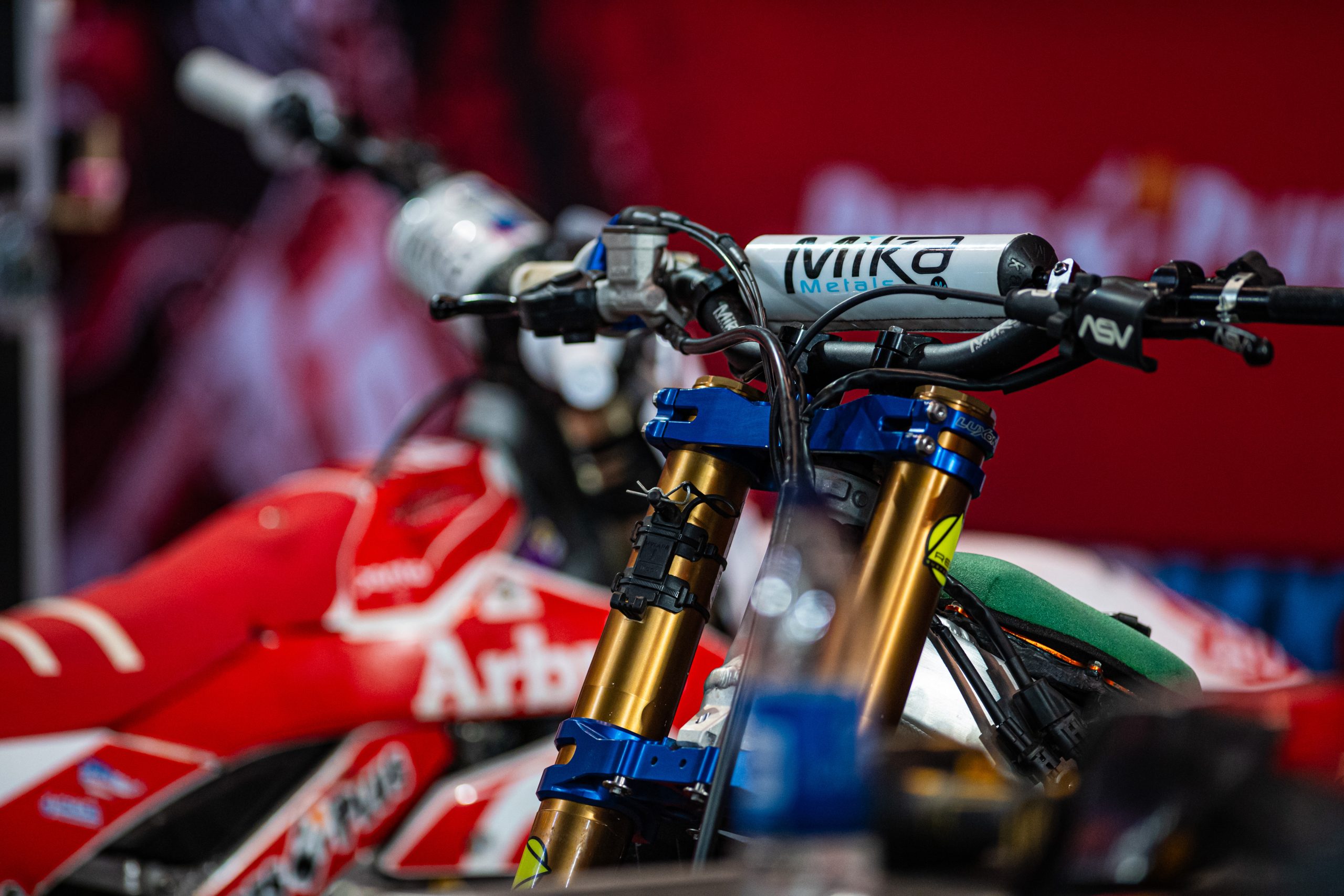
Why Handlebars Matter More Than You Think
World Supercross racers are incredibly, fit, lithe and strong motorsports athletes and are manipulating the motorcycle with many different muscle groups. An obvious area of anatomy that takes a lot of abuse (apart from the back and it’s natural ‘shock absorption’ potential) are the arms and hands: not only for bike control but exerting and withstanding forces across the racetrack.
For this reason, some of your favourite star names will have tested and selected different bends and construction of handlebars (and in a few cases the softness, and compliance of handlebar grips and their patterns) as part of that configuration for optimum race feeling. There are several prominent names that lend their expertise and R&D to this field, like Britons Renthal and Americans ProTaper.
Performance vs. Customisation: The Two Key Goals
Converting standard dirtbike technology for elite level racing, like World Supercross, is often motivated by two main objectives and handlebars are no different. “The first one is performance: better materials and product design reduces vibration and impact for the rider, allowing them to ride faster and harder for longer,” Renthal’s U.S. Brand Manager, Paul Perebijnos, explained to us. “The second gain is the ability to customise set-up to a specific build or skill set or the riding discipline,” he adds. “This allows the rider to find elevated comfort, so they can push the edge and reduce their lap-time.”
Performance for handlebars in World Supercross means more durability and resistance. This translates to more safety and is essential for the jumps, rhythm sections and the whoops of supercross tracks. It is also why stock bars are usually swapped out because there is a big difference of demand from the weekend hobby rider to a professional who will be training and racing at pace several times a week. “Production handlebars used by Original Equipment Manufacturers (OEMs) are often specified by price first; this means cheaper materials that don’t perform as the racer needs,” Paul says.
Renthal MD, Rees Whittal-Williams, points out that Renthal customer products are also frequently the choice for OEMs and that’s because they have passed the grade for racing. “We are proud to supply handlebars to Honda, Kawasaki and Suzuki amongst others and feel that helps demonstrate the quality of our products,” he says. “That said we still have options in our aftermarket to help customers tailor the bike for them, bearing in mind that the OEMs will be choosing a compromise to suit an average rider.”
Perebijnos brings the racing perspective. “Some [other] OEM bars are more likely to bend or deform in a crash, reducing the opportunity to finish the race in the highest position possible and gather most points possible.”
Inside the Engineering: Materials, Bends and Bar Architecture
Handlebars are impressive feats of engineering. In the last five-ten years automation has enabled companies like Renthal to hone their manufacturing processes. The firm has a mix of robotics and skilled hand workers on the factory floor in the UK to produce their range of bar offerings and lock-on grips. The fabrication and ‘bend’ (this being the shape and angle of the bars), width and weight involve complex melds of material and metals. Some have a ‘crossbar’ form for even more rigidity.
The architecture is also advanced. Renthal’s patented Twinwall bars are apparently from tubes of aircraft design principals. ProTaper’s Evo bar tubes are made from 7000 series aluminium alloy (again found in aircraft as well as bicycle frames) and the walls are just 4mm thick. Renthal, as the market leader and one of the most popular bars in the race paddock, have set a new ‘bar’ with the Fatbar36. “This uses a new proprietary aluminium and a new clamping diameter to allow us to reduce the weight of the handlebar by 36%,” Whittal-Williams reveals. “This has really been driven by working with race teams whose main focus is on weight and performance.”
Handlebars are an incredibly personal component of the bike set-up and there can be a plethora of choice. World Supercross racers will have lapped supercross tracks for hundreds and hundreds of hours from a young age so will already have a predilection for a brand or shape. The variation then depends on the rider’s height, weight and style as well as their connection with the motorcycle.
How Pro Feedback Shapes the Bars You Can Buy
Interestingly, the bars that then go into production and make it to the dealer shelves will have been created thanks to the feedback from the Pros. “These riders and teams are how new bar bends are born,” Perebijnos says. “By Renthal meeting the demands of the world’s elite racers. We share this info with our customers on our website.”
Tough, tailored and technical: handlebars are yet another little-known area of excellence on World Supercross circuits.