Round 01
/
08 Aug
Canadian GP

Calgary, Canada
McMahon Stadium
McMahon Stadium

Birmingham has never hosted Formula 1 or MotoGP, nor is it home to any major permanent circuit. Yet few British cities have contributed more to the country’s motorsport industry. From tyre development and motorcycle manufacturing to advanced engineering and its location on the doorstep of the UK’s renowned Motorsport Valley, Birmingham has spent more than a century helping shape competitive racing.
The West Midlands has been at the centre of Britain’s automotive industry since the late nineteenth century. Birmingham and the surrounding region became home to some of the country’s most influential manufacturers, including Austin, Jaguar, MG, Rover and Land Rover, while countless specialist engineering firms supplied components to both road and race vehicles.
Motorsport has always depended on this wider industrial network. Every racing motorcycle and competition car is the product of thousands of individual parts, specialist materials and precision manufacturing techniques. Birmingham’s manufacturing businesses developed many of those capabilities long before professional motorsport became the global industry it is today.
Today, advanced manufacturing remains one of the West Midlands’ largest economic sectors, with automotive engineering continuing to employ tens of thousands of people across the region. The city also played host to the 2023 British GP.
Perhaps no building represents Birmingham’s motorsport connections more clearly than Fort Dunlop. Completed in 1917, the factory became one of the largest tyre manufacturing plants in Europe and, for decades, was synonymous with British tyre production.
At its peak, thousands of employees worked at the site, producing tyres that supplied everything from everyday road vehicles to championship-winning racing machinery. Now however, it is converted into luxury homes and shops and restaurants, but the history and building itself remain.
Dunlop has played a defining role in motorcycle racing history. The company has recorded hundreds of victories at the Isle of Man TT and has supplied tyres across Grand Prix motorcycle racing, endurance racing, motocross and numerous other international championships.
Tyre technology remains one of the most important performance factors in modern supercross. Riders have only a small contact patch connecting them to the ground, yet must accelerate, brake and corner on constantly changing dirt surfaces while absorbing impacts from jumps and rhythm sections. Advances in construction, compounds and tread design continue to influence race performance in much the same way they have for generations.
Birmingham itself is not traditionally considered part of Motorsport Valley, the internationally recognised cluster of motorsport businesses centred around Oxfordshire, Northamptonshire and Silverstone, the home of the British F1 Grand Prix and MotoGP races.
However, its location places it within easy reach of that ecosystem. Around 4,500 motorsport companies operate across the UK, with the highest concentration found within a relatively short drive of Birmingham.
Many innovations developed for elite motorsport eventually influence motorcycle and automotive engineering more broadly, from lightweight materials and electronics to manufacturing techniques and data analysis.
Motorcycles have long been part of Birmingham’s industrial identity. The city was home to BSA (Birmingham Small Arms Company), which became the world’s largest motorcycle manufacturer during the 1950s. BSA motorcycles were exported globally and competed extensively in off-road competition, trials and road racing.
Nearby Solihull has recently welcomed a new factory and HQ for Norton motorcycles, with the Commando 961 being produced there while the area has also played an important role in automotive engineering through Land Rover, while Coventry—less than 30 miles away—developed into one of Britain’s most important centres for motorcycle and car manufacturing, producing marques including Triumph and Jaguar.
Together, the West Midlands helped establish Britain as one of the world’s leading motorcycle-producing regions throughout much of the twentieth century.
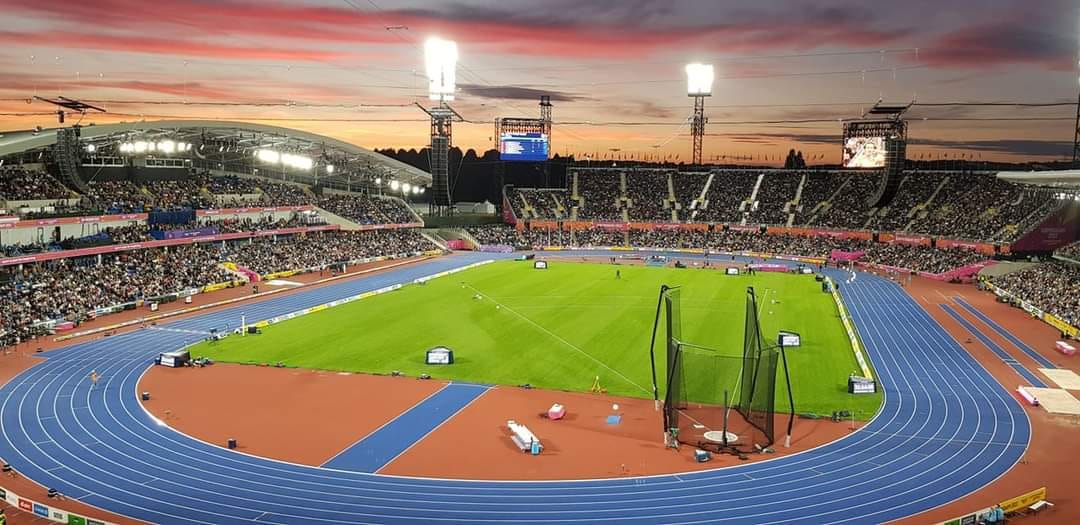
Alexander Stadium may be best known for athletics, but its recent redevelopment has transformed it into one of Britain’s leading multi-purpose sporting venues.
Completed ahead of the Birmingham 2022 Commonwealth Games, the stadium now has a capacity of approximately 18,000 and modern broadcast, hospitality and spectator facilities capable of hosting major international events.
For World Supercross, the venue offers the opportunity to construct a purpose-built race circuit inside a stadium designed to deliver excellent sightlines from every stand.
Unlike permanent motocross tracks, every World Supercross circuit is built specifically for the event. The Birmingham layout will be unique to Alexander Stadium, meaning riders face a completely new challenge rather than relying on previous experience.
Although modern stadium supercross was developed in the United States during the 1970s, Britain has deep roots in off-road motorcycle competition.
The earliest motorcycle “scrambles” held in Britain during the early twentieth century are widely recognised as the origins of modern motocross. The sport evolved through European competition before eventually developing into today’s FIM Motocross World Championship and, later, supercross.
British riders have continued to influence both disciplines, while UK fans have remained among the sport’s most knowledgeable supporters. The World Supercross Championship’s return to Britain acknowledges that history while bringing one of motorcycle racing’s most technically demanding disciplines back to a country where off-road competition has more than a century of heritage.
When the gate drops at Alexander Stadium on Saturday 10 October 2026, the focus will naturally be on the racing. But the choice of Birmingham reflects something broader than geography.
It is a city with genuine motorsport credentials not because of a single circuit or one famous race, but because its engineers, manufacturers and industrial expertise have supported British motorsport for generations.
From the production lines of Fort Dunlop and BSA to the advanced engineering businesses that continue to serve the global motorsport industry today, Birmingham has earned its place in Britain’s racing story. The 2026 World Supercross British GP adds another chapter to that history.