Round 01
/
08 Aug
Canadian GP

Calgary, Canada
McMahon Stadium
McMahon Stadium
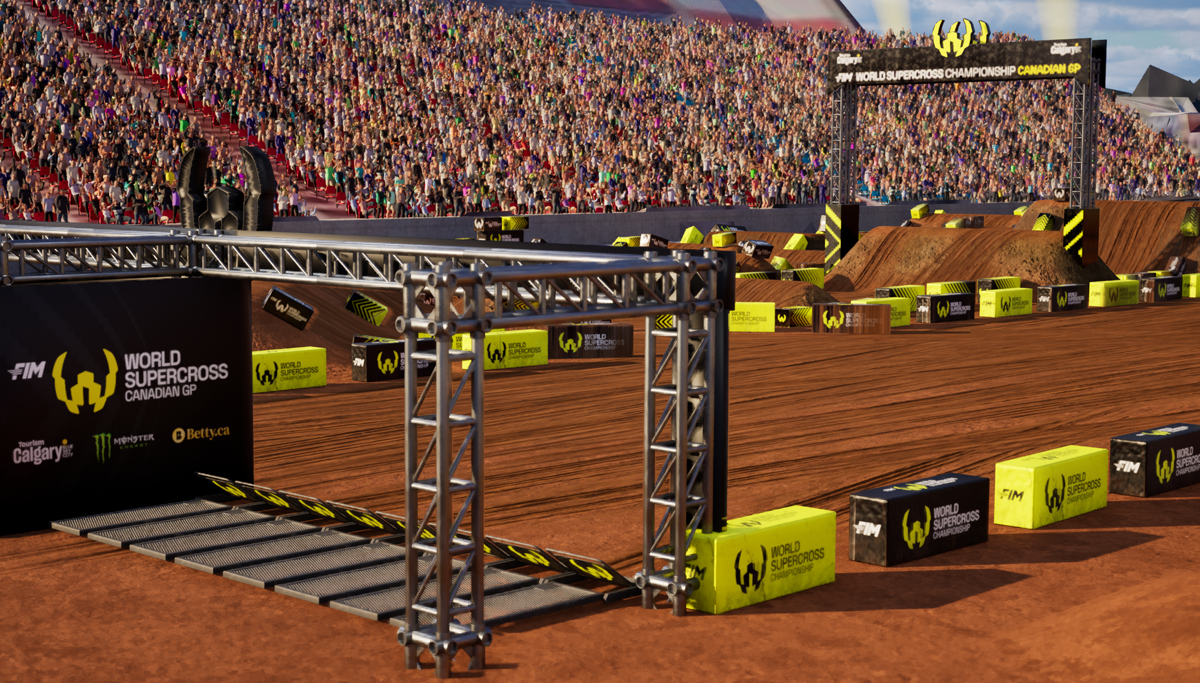
Despite the scale of the build, the track in Canada can be constructed by the Jetwerx team in around 24 hours, with approximately 15 pieces of heavy equipment shaping the surface, jumps, berms and rhythm lanes. The average racing lane will be about 20 feet (6 metres) wide—narrow enough to reward precision, but with selected wider entries and flat turns designed to create passing opportunities.
Riders will launch from an 80–90 ft (24–27 m) start gate onto a start straight ranging from 150 to 375 ft (46–114 m). It is the fastest part of the circuit, with riders expected to reach around 50–60 mph (80–97 km/h) before diving into the first braking zone.
Maximum speed anywhere on the track is likely to peak at around 60–65 mph (97–105 km/h), although Supercross is defined less by outright speed than technical execution.
A full lap is expected to take roughly 45–60 seconds, combining jumps, rhythm lanes, berms, flat corners and the sport’s signature whoop section.
The jump combinations will demand commitment and adaptability. Key distances include a 65-foot triple, a 30-foot double and a 20-foot tabletop, alongside larger Supercross-style obstacles that can range from 65–75 ft for triples, 35–55 ft for doubles, and 30–80 ft for tabletops.
The finish jump can stretch to 60–90 ft (18–27 m), while step-ups and step-downs add vertical changes that test timing, throttle control and suspension setup.
Rhythm lanes are expected to be a major factor in the Canadian GP track design. Typically measuring 150–250 ft (45–75 m), these sections can offer multiple ways through: triple-triple combinations, quad-double lines, double-on/off options, 3-2-3 patterns, manuals and skips. A rider may choose the safest route, the fastest route, or an alternative line to set up a pass.
The whoop section will be one of the defining challenges. Expect around 10–14 whoops across an 80–120 ft (24–37 m) section, each approximately 3 ft (0.9 m) high. With spacing of about 8–10 ft (2.4–3 m), and roughly 14 ft peak to peak, the fastest riders will skim across the tops rather than drop into every trough.
Done well, it is one of the quickest sections of the lap; done badly, it can cost several positions in moments.
Corners will alternate between deep, banked berms and flatter turns. Berms are typically 4–8 ft (1.2–2.4 m) high, with 25–60 ft (7–18 m) radii and banking of around 30–45 degrees. While berms reward momentum and aggression, flat corners create braking battles and passing opportunities, particularly after long rhythm lanes or the start straight.
The physical demands are extreme. Professional riders can experience 3–5 g on landings, up to 1.2 g under braking, and as much as 1.5 g while cornering. On many landings, suspension uses almost its full 300 mm of travel.
At McMahon Stadium, success will come from managing those forces while staying precise through a constantly changing sequence of technical obstacles. But before the race on the track, there is a race against time to get the track built.